

• About
    • Info
    • Storefront
    • Support
  • Work
    • Undergraduate Work
    • Graduate Work
    • Alumni Work
    • Faculty Work
    • Co-op
  • Articles
    • Resource
    • Opinion
  • Community
    • Event
    • Initiatives
[email protected]
Bridge Bridge
  • About
    • Info
    • Storefront
    • Support
  • Work
    • Undergraduate Work
    • Graduate Work
    • Alumni Work
    • Faculty Work
    • Co-op
  • Articles
    • Resource
    • Opinion
  • Community
    • Event
    • Initiatives

On Making

Jan 16, 2014 | Posted by Magdalena Miłosz | Graduate Work |

ABSTRACT by Melissa Ng

Grasping the wooden handle of a dozukime saw with both hands, I make a rip-cut into a block of eastern white pine, leaving behind a 1/64-inch wide kerf. I am cutting a dovetail: a wood joint developed over five-thousand years ago by the hands of our ancestors. Even now, a well-fitted dovetail joint remains one of the strongest, most elegant ways to join wood.
I knew nothing about traditional woodworking when I first picked up a hand-plane, but I was soon inspired by the richness of the craft: the quality of a hand-planed finish, the spirit of craftsmanship, and the nature of material. I was amazed by the wealth of knowledge embodied in craftwork. The tools and materials I encountered spoke to me; I learned to care for them and for my work. How would the things I make endure through time? How would the things I make affect others? In an era where materialism has come to represent a spiritless relationship to the things around us, traditions of craft can teach us how to imbue the human spirit in our work.
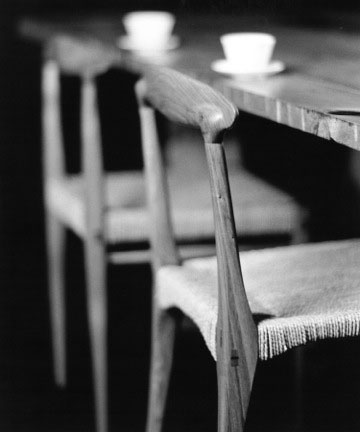
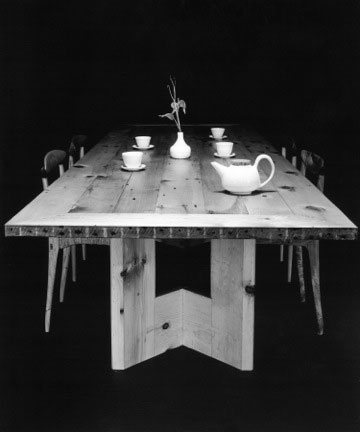
After making a harvest table, four chairs, ninety-four earthenware pots, and a lamp, I reflect on the act of making as a means of discovery. Making affects our thinking and our approach to material and environment. Making can help us develop a craftsman’s capacity to listen, a great respect for material, and a desire to make better objects for posterity. Making is learning.

Supervisor:
Dr. Tracey Winton, University of Waterloo

Committee Members:
Prof. Ryszard Sliwka, University of Waterloo
Prof. John McMinn, University of Waterloo

External Reader:
Paul Dowling, Dowling Architects

The Defence Examination took place: Tuesday, January 14, 2014 5:00 PM ARC 3003 (Loft)
 

Tags: makingMelissa Ngthesis

About Magdalena Miłosz

I am a graduate student at the University of Waterloo School of Architecture, currently completing my MArch thesis on the design and collective memory of Indian residential schools in Canada.

You also might be interested in

Re:PoST Thesis to Practice

Re:PoST Thesis to Practice

Nov 5, 2014

Re:PoST is an annual event which explores opportunities for disseminating architecture design and research. The team is currently developing this year's symposium focusing on the translation from thesis to practice and are looking from ideas and input from graduate students.

Brick: A Story of Construction

Brick: A Story of Construction

Aug 1, 2013

ABSTRACT by Samantha Oswald Brick. A simple object, but one[...]

On Laying Out your Thesis in InDesign

On Laying Out your Thesis in InDesign

Jan 27, 2015

Recently defended student Vikkie Chen has compiled a comprehensive guide to formatting a thesis in InDesign covering everything from front matter to end notes, paragraph styles to figure lists. For any current graduate student working on their thesis or even undergraduates building their portfolio, her guide is extremely helpful.

Search

Top Posts This Month

  1. Beggs - Chemo Suite Before and AfterTHESIS: Healing through Architecture – Bridge
  2. The generalized typologies of sites that van Eyck would use to create his playgrounds: (from left) Boulevard, Courtyard, Plaza, and ParkCase Study: van Eyck’s Playgrounds – Bridge
  3. BRIDGE_ICON_InDESIGN_squareOn Laying Out your Thesis in InDesign – Bridge
  4. STUDENT WORK_MGertler-MDavis -07STUDENT WORK / Beyond the Campo Marzio – Bridge
  5. BRIDGE_ICON_Template_STUDENTWORKSTUDENT WORK – ROME / Grafting / 4A Studio – Bridge

© 2016 — BRIDGE.