

STUDENT WORK - ROME / Grafting / 4A Studio
The Rome program is fundamental to the architectural education of any Waterloo Architecture student. Often, however, work that is produced by the students in Rome is unable to be seen by the rest of the UWSA community until the final Rome Show. We wanted to showcase some of the interesting student work being executed throughout the term. Here are some excerpts of projects from the most recent project undertaken by the class currently studying in Rome.
GRAFTING
“The concept of grafting presupposes also one of hybridisation, of genetic variations, of the invention of new building types, figures and situations, starting from the mutation of existing patters rather than their re-invention” – Cino Zucchi
The Aurelian Walls seem to be the ideal context to investigate the concept of grafting. Students were asked to design a house-studio for an artist in a selected location.
//
Promenade House
by J. Cameron Parkin
Located in a vibrant residential neighborhood, this project is centered on the relationship between the public and the artist as mediated by galleries of artwork. In the separation of the artist’s living space and the semiprivate studio, dual promenades are created. Structure organized to recall the original form of the wall’s corridor both supports artwork to surround the public promenade at ground level, as well as an upper walkway for the artist. These ribbons of artwork then wrap around the private living and semi-private studio courtyard, curating privacy. While there is already a park following the wall on this site, it appeared underused. This project hopes to inspire the use of the park and exploration of the wall by engaging the nearby residents as well as travellers at an important node.
Aurelian Wall House
by Stephane Gaulin-Brown
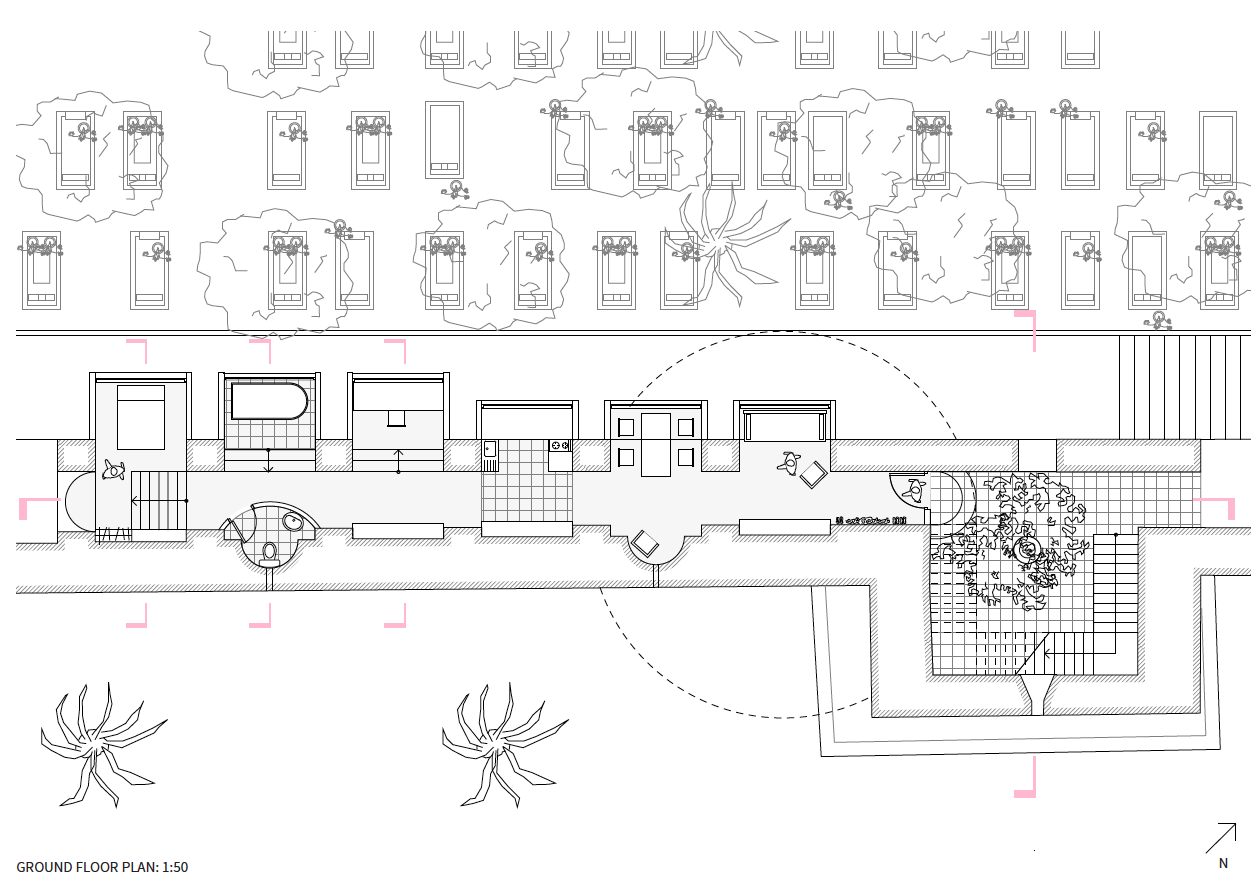
The wall house aligns itself with two unique contexts: the geometry of nearby objects also embedded in the wall, and the non-christian graveyard. The circular terrace, which sits on top of the wall, visually connects and anchors the building towards the pyramid of Cestius and the rectangular guard towers. It proclaims its own space along the wall.
Inside, most of the house is shielded from views of the graveyard, except the bath. Here the floor steps down and the window sits flush with the tile. It is an embodied space of bathing and contemplation, where one’s own nakedness, in contrast with the graveyard, reveals the fragility of the human body.
Impermanent Permanence
by Jack Lipson
As a city of layers, Rome’s urban fabric is constantly being altered. Whether it is by means of renovation, renewal, hybridization, or new construction - it is almost impossible to distinguish between an ‘original’ Rome and the amalgamation of grafted architecture that surrounds us on every street corner, piazza, and niche of this city. However, with a history that spans multiple millennia - it is hard to consider Rome as a ‘newly revived’ city - but rather a timeless artifact from a rich past. A city of both permanence and temporarity.
The ambition of the ‘Graffiti’ studio and residence is to explore this duality - an architecture that reflects the constantly evolving city. As a studio for a graffiti artist, the project embodies the notion of the ‘impermanent permanent’ - a building that takes a form derived from the occupant. A flexible space that allows the artist to both work and present, ‘Graffiti’ aims to create a public node of artistic traffic, providing a space for artists alike to create.”


Leave a Reply