

THESIS: Algae Textile
Abstract by Petra Bogias
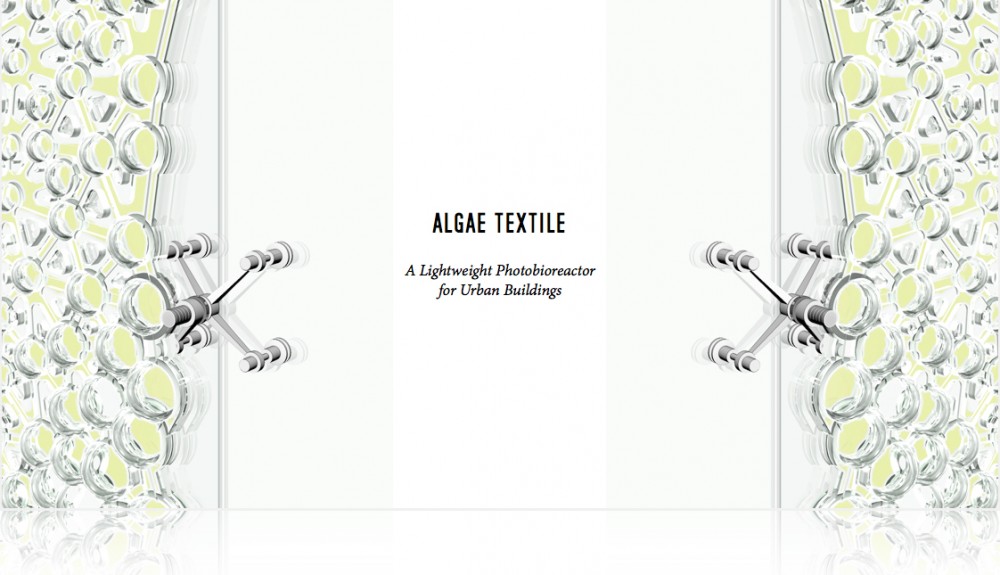
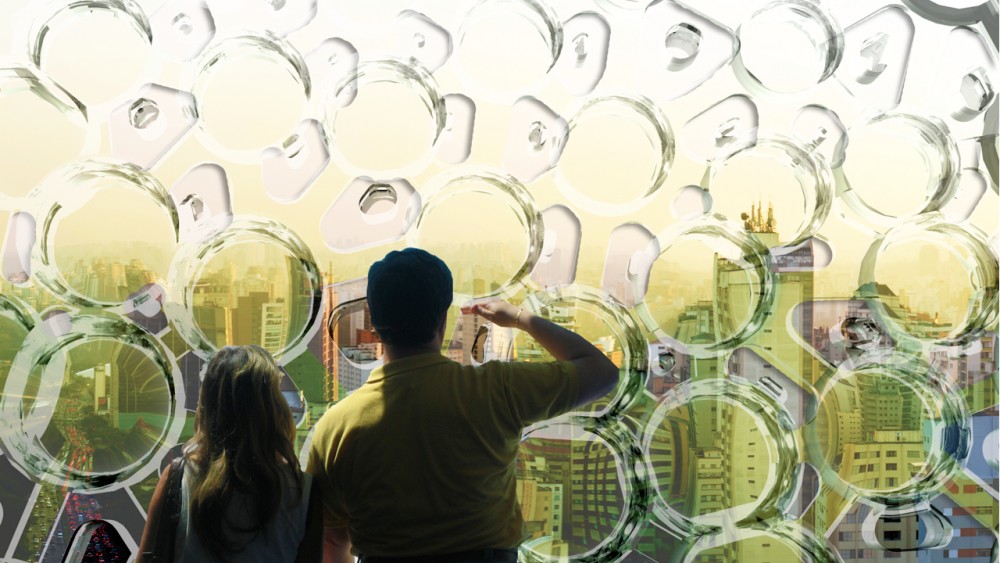
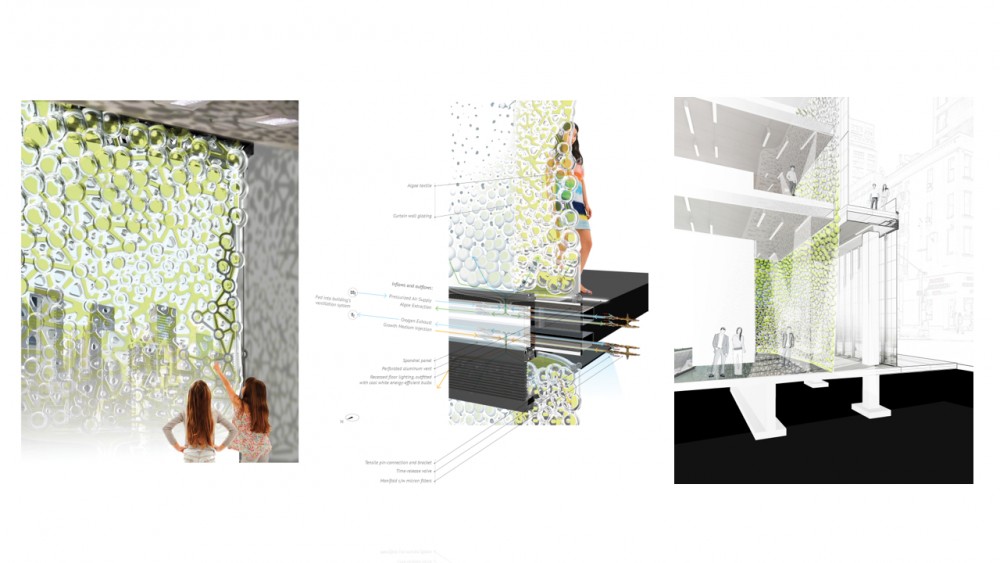
By innovating the photobioreactor, the growth of algae can be deployed as a performative and ecological layer within contemporary building systems. Proposed is an algae textile: a building–integrated photobioreactor organized as a flexible membrane, whose form can be adjusted according to given programmatic and environmental conditions. This organization translates functions from industrial photobioreactors into forms that can operate at the lightweight scale of an enclosure or partition, demonstrating how algae might be integrated within the layers of a building as an alternative ecology. A typical curtain wall is used as an example to test new standards of geometry and materiality using the membrane, where parametrically–controlled quasiperiodic and conformal geometries are studied. These offer geometric plasticity when generating the reactor’s organization, refining its ability to modulate light and view by varying porosity, and tailoring it to the characteristics of a given space. When paired with the minimal dimensions of transparent thin–film polymers, this method of forming enclosures shows how renewable resources such as algae can be positioned within buildings without an expansion in the wall assembly and easily retrofitted into existing ones to create performative next-generation building skins.
To support these qualities, design principles addressing both qualitative and quantitative measures are emphasized, aiming to define a photobioreactor’s required behaviours when used specifically as a component within urban buildings. This direct integration of biology in architecture asserts that building material can be seen as a productive entity, contributing to the discourse surrounding postnatural urban ecology, and drawing from research exploring articulated material systems, including Achim Menges’ composite membranes and Neri Oxman’s use of digital morphogenesis. In this way, the industrial process of algae cultivation can be translated into complimentary building systems which acknowledge both the productivity and the aesthetic of algae: as agile components of a larger renewable resource network, and as icons for a self–sufficient urban lifestyle.
Supervisor:
Philip Beesley, University of Waterloo
Committee Members:
Ila Berman, University of Waterloo
Maya Przybylski, University of Waterloo
External Reader:
Liat Margolis, University of Toronto
The defence examination will take place Wednesday September 10, 2014 at 10:00am in ARC 2003 (Photo Studio)
A copy of the thesis is available for perusal in ARC 2106A.




Leave a Reply